Home / Blog / Step The F*ck Up
STEP THE F*CK UP
Small Steps: Why Tiny Daily Changes Beat Big Plans Every Time
Part of the series How Do I Change My Life Without Blowing It Up First?
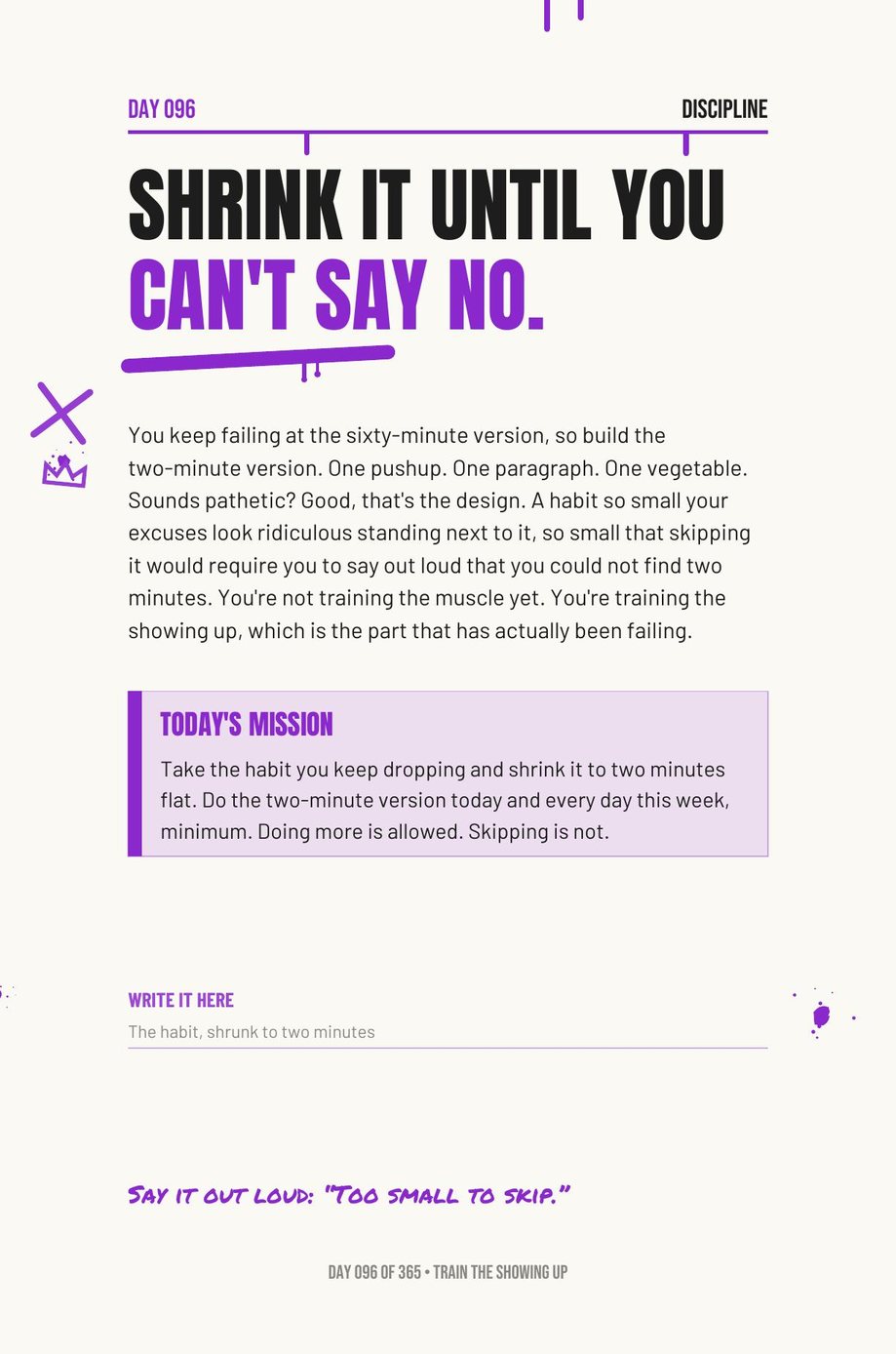
One pushup. One paragraph. One vegetable. The book's Day 96 page anticipates the objection, sounds pathetic, and answers it: good, that is the design. A habit so small your excuses look ridiculous standing next to it, so small that skipping it would require saying out loud that you could not find two minutes. Tiny daily changes beat big plans not because they are more virtuous but because they are the only ones that survive contact with a real week, and a change that survives compounds while a change that stops does not.
Why big plans fail by Day 9
A big plan is a peak, and a peak has to be climbed on days you feel like climbing, which is a third of them. The first bad day, the flu, the deadline, the funeral, the plan is skipped once, and Day 109 explains what happens next: once is weather, twice is a decision, and big plans are skipped twice because the second day still needs the full climb. The Day 200 page gives the numbers: most daily programs die by Day 9, almost all by Day 40. The size of the plan is the reason.
Why the tiny version compounds
The two-minute rep survives the bad day because it does not need the full battery; it is done on forty percent, tired, in the mess. That survival is the whole mechanism: three hundred sixty-five small reps is a different person and twelve large ones is a story about January. And the tiny version grows without permission, because a person who does one pushup every day for a month does not stay at one; they stay at every day, which is the part that was ever hard.
The method: three, then three, then now
Take the goal that overwhelms you and cut it into three pieces. Cut the first piece into three again. Do the smallest one before you close the book. Overwhelm is a math error, lifting the whole staircase instead of a step, and the cut fixes the resolution so that a first move becomes visible. Then chain the small rep to something you already do, after the coffee, after the teeth, so it inherits the hook's reliability. Then never twice. That is the entire small-steps system, and it fits on one page because it has to.
Where the pages are
Month One, too big, shrink it; Month Four, shrink it until you cannot say no; the whole book, one page a day, which is the small step applied to a year. Shrinking the goal is the cut; the no-zero day is the smallest rep made a rule; changing faster explains why small is the fast version; the daily guide puts it in sequence. One pushup, today, in a certain book that thinks pathetic is the design.
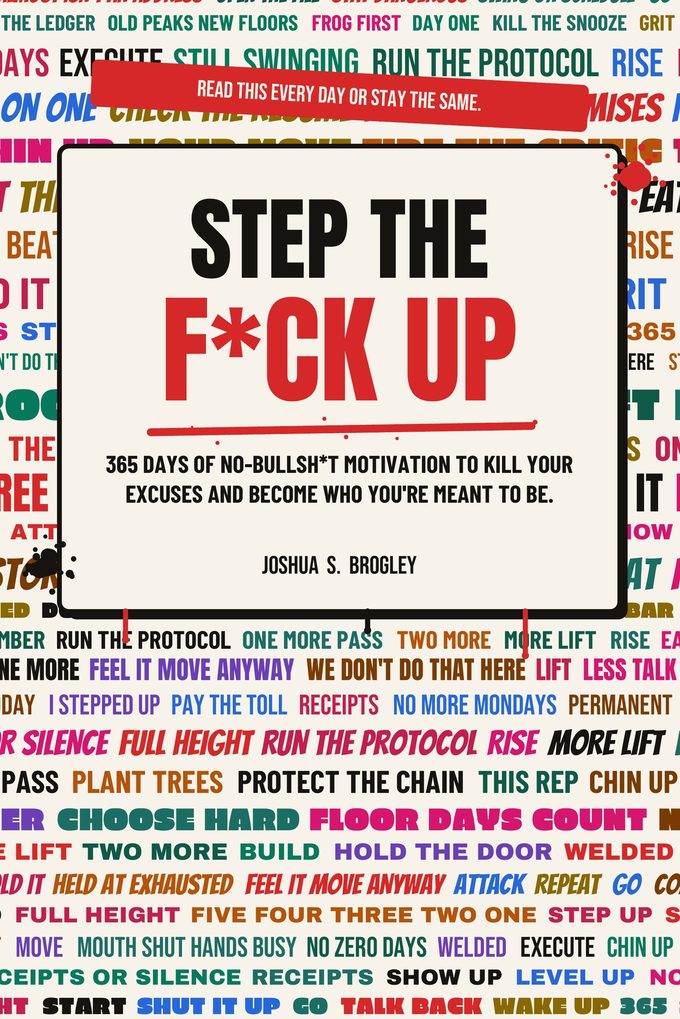
Step The F*ck Up
365 days of no-bullsh*t motivation. One page, one mission, two minutes. Miss never twice.
Why do small habits work better than big goals?
Because they survive the bad day. A two-minute rep is done tired, on forty percent, in the mess, and a habit that survives compounds while a big plan that stops after the second miss does not. Most daily programs die by Day 9 for this reason.
How small should a new habit be?
So small your excuses look ridiculous next to it: one pushup, one paragraph, one vegetable. Skipping it should require admitting you could not find two minutes. It grows on its own once it is never skipped.
More on Step The F*ck Up
- Your Eulogy Is Being Written Now, in Ordinary Hours
- Why You Self-Sabotage Right Before It Works
- Why Strength Is a Life Skill, Not Vanity
- Why Sleep Comes Before Everything: Sleep Is a Performance Drug
- Why Regret Hurts More Than Failure: The Compounding Problem
The method behind every book
- Which 365-Day Book Should I Start With? A One-Minute Guide
- What Is a No Zero Day? The Rule That Saves a Bad Week
- What Is a Realistic Morning Routine? Two Minutes, Not Two Hours
All articles about Step The F*ck Up → · The book page → · All the books →
written by the author, at the kitchen table, after work.