Home / Blog / Step The F*ck Up
STEP THE F*CK UP
How to Build a Bounce Routine: Fighters Do Not Improvise the Get-Up
Part of the series Month Ten: 31 Days of Training the Only Thing That Matters, How Fast You Get Up
Fighters do not improvise the get-up. It is drilled until it is automatic: glove down, knee up, eyes on the corner, stand before eight. The book's Day 283 page says you need the same drill for life's knockdowns for the same reason they do. In the minutes after impact, a brain with a protocol moves, and a brain without one spirals and calls the spiral thinking. You already own every tool this requires. The mission is to stop them being tools and make them a sequence.
Why a routine and not a mindset
A mindset is a thing you have on good days. A routine is a thing you run on bad ones, when the mindset is unavailable because the part of the brain that holds it has just been hit. The bounce routine is designed for the exact moment you cannot think, which is why it has to be short, physical and written down: three steps, each one an action rather than an attitude, drilled on easy days so that on the hard day the body starts moving before the voice has finished narrating the disaster.
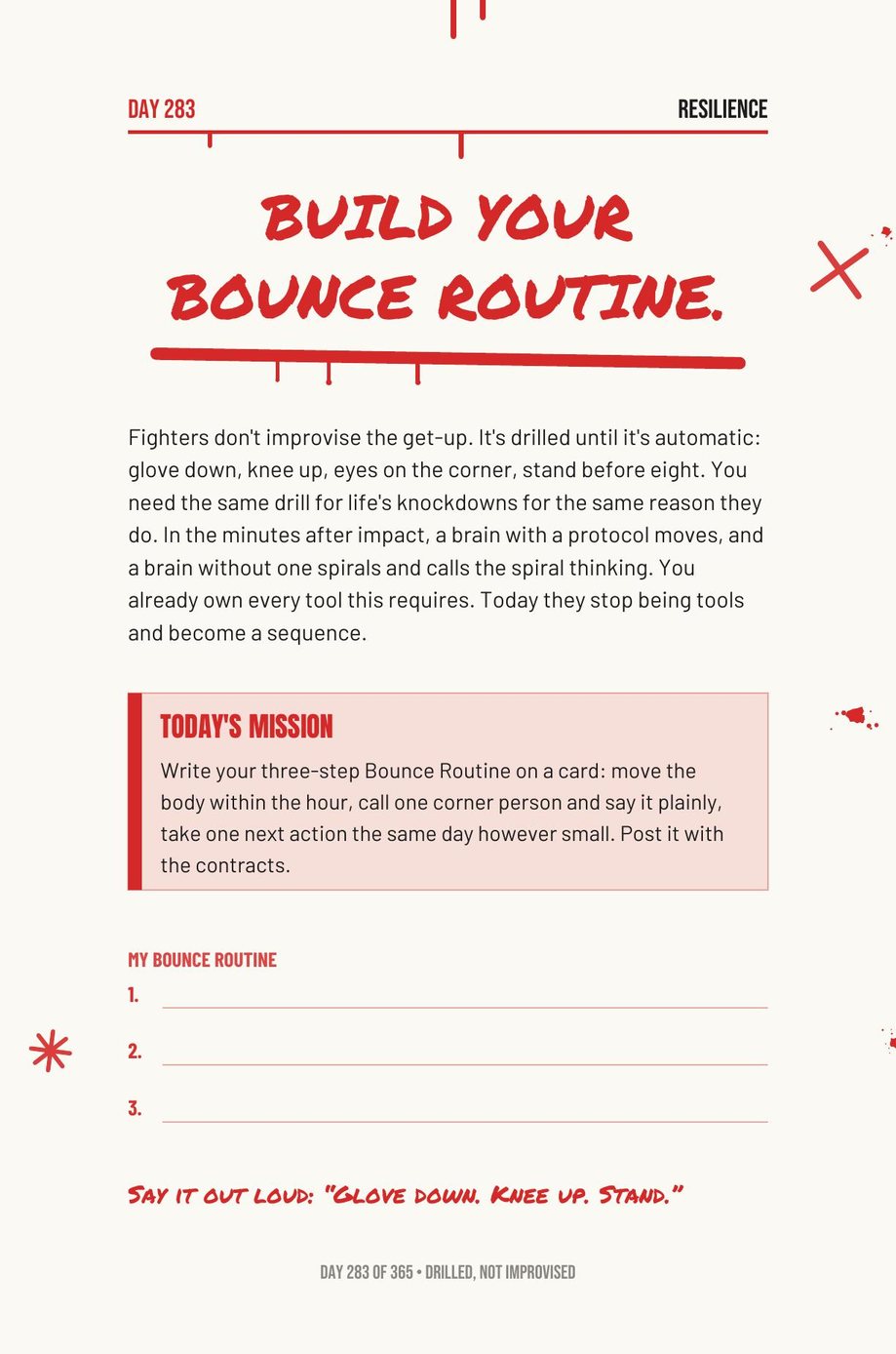
The three steps, from the book's own toolkit
Step one is nearly always physical, because the body is the fastest way to interrupt a spiral: move, water, outside, the two minutes from the first-hour protocol. Step two is the timer: the sulk window from Day 276, set, honored, closed. Step three is the smallest next action, the data extracted from the setback in three lines and one thing done about it today. Yours may differ; the mission is to write three steps in your own words and then rehearse them once this week on a day nothing has happened, because a routine that has only ever been run in a crisis is not a routine, it is a hope.
Rehearse hard days on easy ones
Day 286 makes this a separate page because it is the part people skip. The drill is only automatic if it has been run when it was not needed, and the book's method is a rehearsal: pick an ordinary evening, imagine a specific hit, run the three steps for real, water, timer, one action, and notice how fast the sequence is when there is no pain in the way. That speed is what you are buying for the real day. Fighters do not learn the get-up in the ring, and the ring is coming.
Where this sits
Day 283 of Month Ten, Resilience, the page where the month's tools become a sequence. The sulk window is step two; the data feeds step three; the five-year test sorts which hits deserve the routine at all; bouncing back is the longer companion. Three steps, written and rehearsed once this week, in a certain book that drills the get-up.
Step The F*ck Up
365 days of no-bullsh*t motivation. One page, one mission, two minutes. Miss never twice.
What is a bounce-back routine?
A three-step drill for the minutes after a hit, written in advance and rehearsed on easy days: usually a physical interrupt, a pre-set sulk window, and the smallest next action. It exists for the moment you cannot think.
How do you recover quickly from bad news?
By running a routine rather than reaching for a mindset. The mindset is unavailable right after impact; the routine moves the body first, lets a timer decide when the feeling stops steering, and then takes one small action.
More on Step The F*ck Up
- Your Eulogy Is Being Written Now, in Ordinary Hours
- Why You Self-Sabotage Right Before It Works
- Why Strength Is a Life Skill, Not Vanity
- Why Sleep Comes Before Everything: Sleep Is a Performance Drug
- Why Regret Hurts More Than Failure: The Compounding Problem
The method behind every book
- Which 365-Day Book Should I Start With? A One-Minute Guide
- What Is a No Zero Day? The Rule That Saves a Bad Week
- What Is a Realistic Morning Routine? Two Minutes, Not Two Hours
All articles about Step The F*ck Up → · The book page → · All the books →
written by the author, at the kitchen table, after work.