Home / Blog / Step The F*ck Up
STEP THE F*CK UP
How to Shorten the Sulk: Feel It Fully, on a Timer Set in Advance
Part of the series Month Ten: 31 Days of Training the Only Thing That Matters, How Fast You Get Up
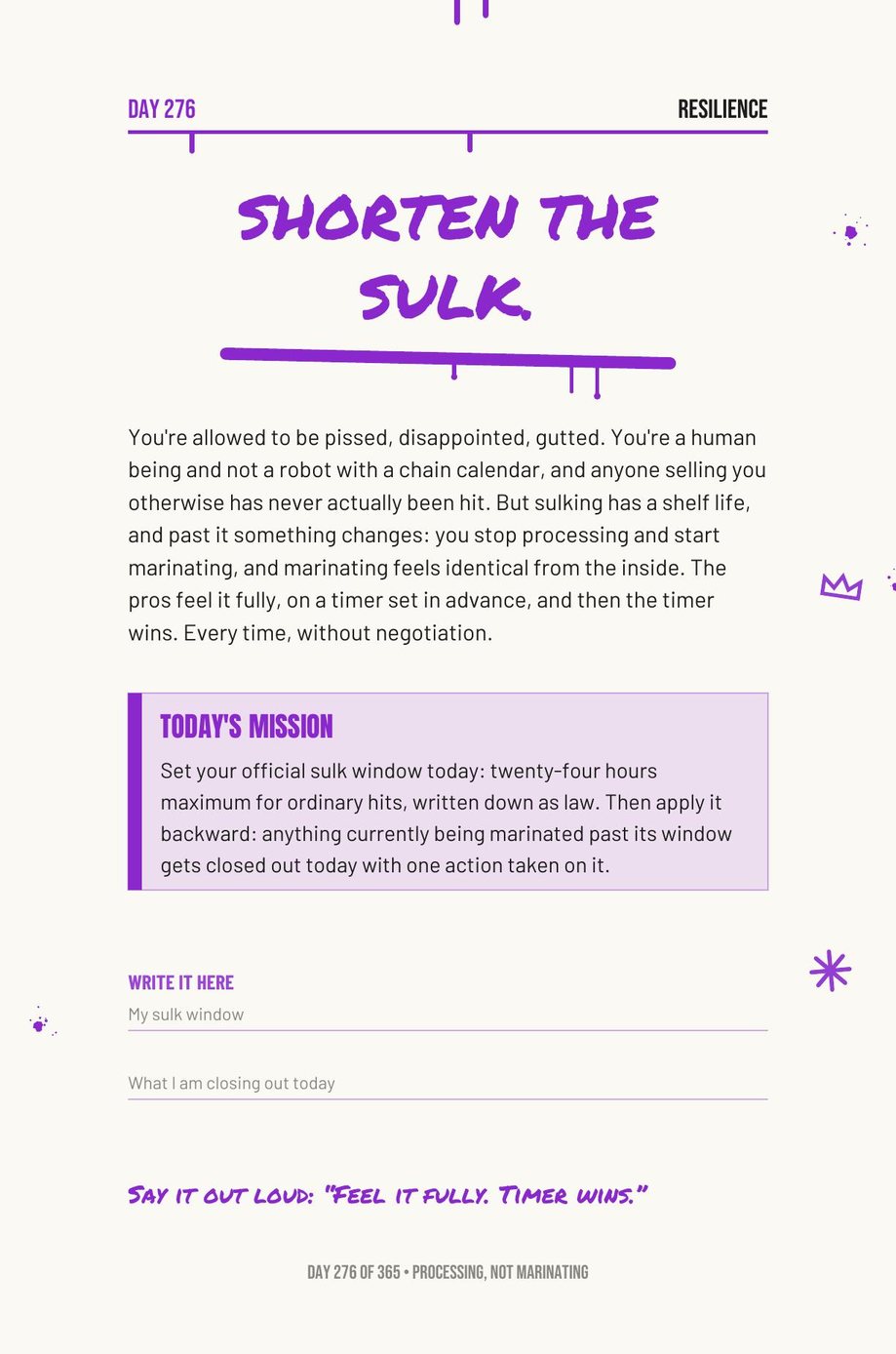
You are allowed to be angry, disappointed, gutted. The book's Day 276 page is explicit that you are a human being and not a robot with a chain calendar, and that anyone selling you otherwise has never actually been hit. But sulking has a shelf life, and past it something changes: you stop processing and start marinating, and marinating feels identical from the inside. The pros feel it fully, on a timer set in advance, and then the timer wins. Every time, without negotiation.
Processing versus marinating
The first hours after a hit are processing: the feeling is doing work, sorting what happened, letting the body register the loss. Somewhere after that the work is done and the feeling continues anyway, and now it is marinating: the same thoughts on the replay channel, the same conversation rerun, the wound refreshed hourly like a feed. The two feel the same, which is why nobody notices the switch, and why the only reliable way to catch it is external: a clock, set before the feeling started, that does not care how the feeling feels.
Set the window today, before you need it
The mission is to set your official sulk window now, on a day nothing is wrong: a number of hours for a bad day, a number of days for a bad week, the size of the loss. Write it in the book. The timer has to be set in advance because a person mid-sulk will always argue for an extension, and will always win the argument, because they are the only one in the room. A pre-set window is a decision made by the calm version of you, which is the only version qualified to make it.
When the timer wins
The window closes and the next thing starts: the bounce routine from Day 283, three steps drilled in advance, or simply the smallest next action on the setback's data. Not because the feeling is gone; it usually is not. Because the timer won, and letting the timer win is the rep. The book's line about the pros is not a claim that they hurt less. It is a claim that they have separated feeling from scheduling, and that the separation, practiced, is most of what resilience turns out to be.
Where this sits
Day 276 of Month Ten, Resilience, immediately after setbacks-as-data, because the data cannot be read mid-sulk and the book knows it. The data is what you extract when the window closes; the bounce routine is what runs next; the 3 a.m. rule from Month Three is the same principle, verdicts postponed to a better-qualified hour. A window, written today, in a certain book that lets the timer win.
Step The F*ck Up
365 days of no-bullsh*t motivation. One page, one mission, two minutes. Miss never twice.
How long should you let yourself feel bad after a setback?
As long as the window you set in advance, on a calm day: hours for a bad day, days for a bad week, sized to the loss. Feel it fully inside the window; when the timer ends, run the next step regardless of whether the feeling has.
What is the difference between processing and wallowing?
Processing does work: sorting, registering, grieving. Marinating repeats the same thoughts after the work is done. They feel identical from inside, which is why a pre-set clock, not the feeling, decides when one becomes the other.
More on Step The F*ck Up
- Your Eulogy Is Being Written Now, in Ordinary Hours
- Why You Self-Sabotage Right Before It Works
- Why Strength Is a Life Skill, Not Vanity
- Why Sleep Comes Before Everything: Sleep Is a Performance Drug
- Why Regret Hurts More Than Failure: The Compounding Problem
The method behind every book
- Which 365-Day Book Should I Start With? A One-Minute Guide
- What Is a No Zero Day? The Rule That Saves a Bad Week
- What Is a Realistic Morning Routine? Two Minutes, Not Two Hours
All articles about Step The F*ck Up → · The book page → · All the books →
written by the author, at the kitchen table, after work.