Home / Blog / Step The F*ck Up
STEP THE F*CK UP
The Five-Year Test: Your Stress Does Not Size Its Targets
Part of the series Month Ten: 31 Days of Training the Only Thing That Matters, How Fast You Get Up
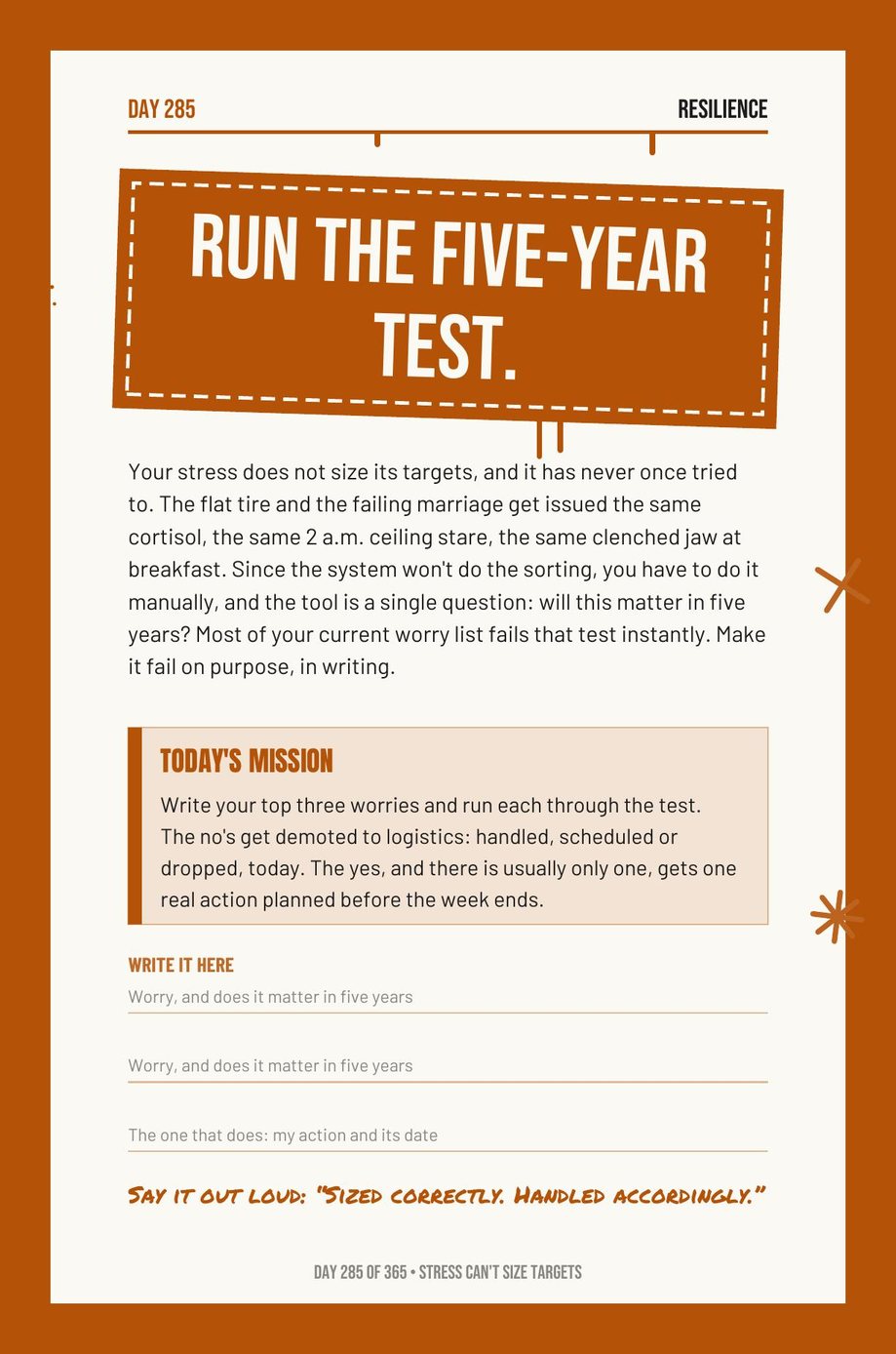
Your stress does not size its targets, and the book's Day 285 page notes it has never once tried to. The flat tire and the failing marriage get issued the same cortisol, the same 2 a.m. ceiling stare, the same clenched jaw at breakfast. Since the system will not do the sorting, you have to do it manually, and the tool is a single question: will this matter in five years? Most of your current worry list fails that test instantly. The mission is to make it fail on purpose, in writing.
Why the body cannot tell the difference
The stress response is old and binary. It was built for one kind of threat and fires the same way for a missed deadline as for a bear, because it does not read context, it reads arousal. So the person with a full worry list is running the full alarm all day for items that, rated honestly, are mostly noise, and the alarm is expensive: it costs sleep, patience, judgment and the body the month before this one spent thirty days rebuilding. The five-year test is a manual override for a system that does not have one built in.
The mission: three worries, three answers, in writing
Write your top three worries right now. For each, answer the question honestly: will this matter in five years? Yes, no, or only if I do nothing. Most people find at least two of the three fail the test outright, the presentation, the awkward email, the thing someone said, and the effect of writing no next to them is immediate and slightly embarrassing, because the body was treating them as the marriage. The one that passes gets the full resources: the bounce routine, the data extraction, the real work. The others get a shrug, on purpose.
What passes, and what to do with it
The worries that pass the test are the ones the rest of the month is for: the health thing, the relationship thing, the money thing that compounds. The test does not shrink them; it clears the noise around them so they can be seen and worked, which the noise was preventing. The slow book runs the same logic at the scale of a life: three points, a line, and the question of whether the line is going where you want, which is the five-year test asked once a decade instead of once a week.
Where this sits
Day 285 of Month Ten, Resilience, after the bounce routine, because the routine is expensive and this decides what deserves it. The sulk window is sized by the same test; setbacks as data is what the passing worries get; drift in the slow book is the five-year question asked about a whole life. Three worries, three honest answers, in a certain book that sorts what the body cannot.
Step The F*ck Up
365 days of no-bullsh*t motivation. One page, one mission, two minutes. Miss never twice.
How do you stop worrying about small things?
Write your top three worries and answer for each: will this matter in five years? Most fail instantly, and writing no beside them releases the alarm the body was running. The ones that pass get the real resources.
Why does everything feel equally stressful?
Because the stress response reads arousal, not context, and fires the same way for a flat tire as for a failing marriage. It will not sort the list; the five-year test is the manual override.
More on Step The F*ck Up
- Your Eulogy Is Being Written Now, in Ordinary Hours
- Why You Self-Sabotage Right Before It Works
- Why Strength Is a Life Skill, Not Vanity
- Why Sleep Comes Before Everything: Sleep Is a Performance Drug
- Why Regret Hurts More Than Failure: The Compounding Problem
The method behind every book
- Which 365-Day Book Should I Start With? A One-Minute Guide
- What Is a No Zero Day? The Rule That Saves a Bad Week
- What Is a Realistic Morning Routine? Two Minutes, Not Two Hours
All articles about Step The F*ck Up → · The book page → · All the books →
written by the author, at the kitchen table, after work.